Find the shared input and the personal choice
Check which dice results everyone may use and whether the active player has extra options. Some games offer a common pool, while others ask players to select combinations or follow different phases. A roll visible to all players does not mean every player applies it in the same way.
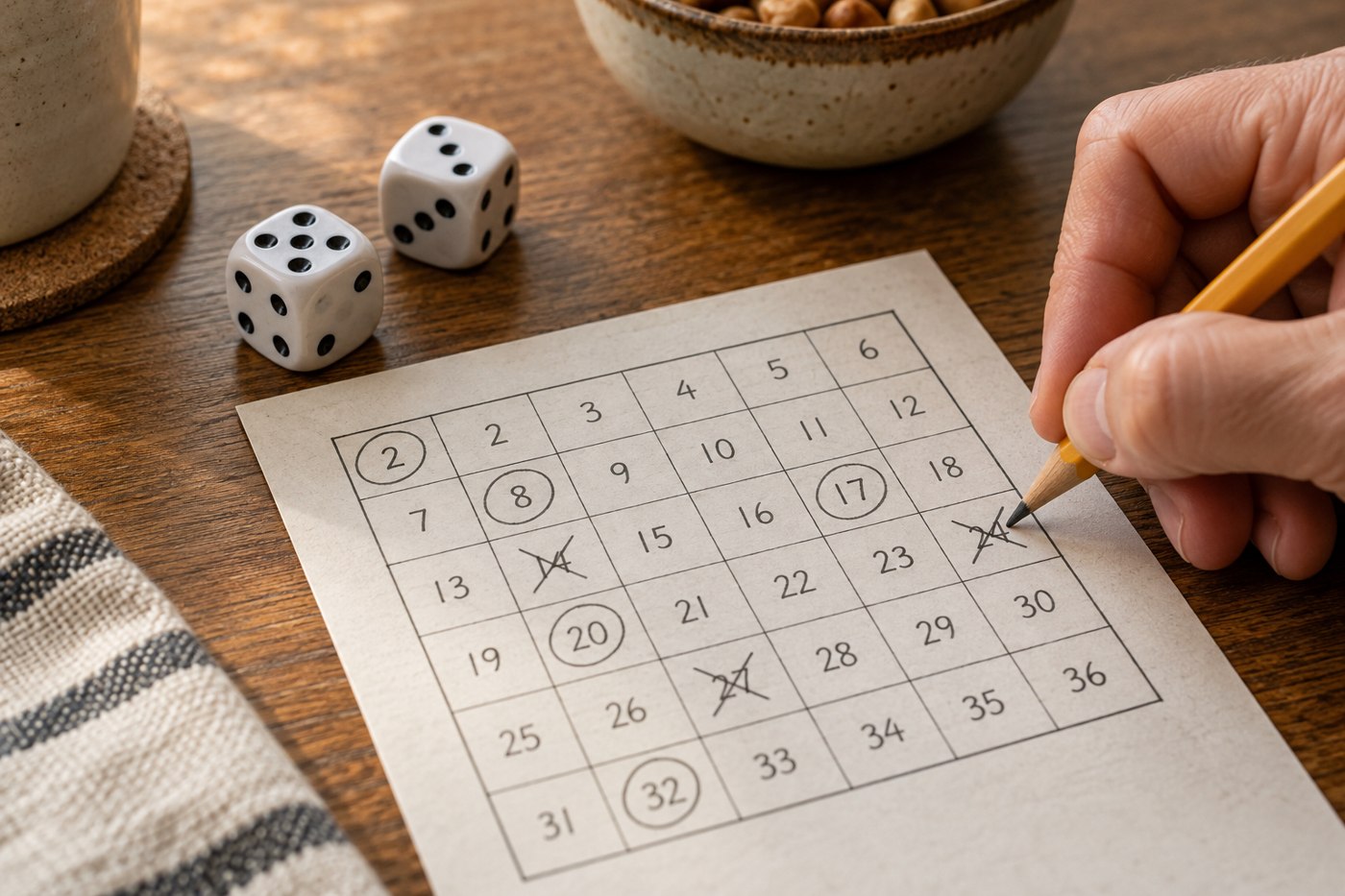
Look at the sheet before starting. Identify where marks are legal, which choices close future spaces and how bonuses connect different areas. In an illustrative number-row game, writing a large number early may score now but leave fewer legal places for later results. Another player can use the same roll differently because their row has developed another shape.
Read restrictions before chasing combinations
A sheet may require increasing numbers, adjacent spaces, complete groups or a particular colour. Check whether gaps can be filled later and whether a crossed-out choice can ever be changed. Many designs make marks permanent, so a neat-looking pattern can still be illegal.
Know what happens when you cannot or choose not to use a result. A pass may be harmless, limited or penalised. Do not mark a poor option automatically if the rules allow a useful pass, and do not assume passing is free because it was free in another game.
Balance immediate marks with future room
A small reward can preserve flexibility, while a large one may close a section. Compare what the move adds with what it prevents. Near the end, unused space may have little value; early in the game, closing too much can leave you with few choices on later rolls.
Bonus chains deserve careful resolution. If filling a group grants an extra mark, complete that instruction before taking another unrelated action. Use the game's method for recording consumed bonuses. A crowded sheet should still show which benefits have been earned and which have already been used.
Keep the shared pace clear
Announce the dice result and allow everyone to finish marking before rolling again. A clear ready signal prevents a player from losing track while someone else rushes ahead. If people need to inspect the dice, leave them visible instead of scooping them up as soon as you finish your own sheet.
Provide suitable writing tools and a firm surface. Confirm whether the supplied sheets are intended for pencils, pens or a reusable surface, and avoid using a marker that will damage a board. If copying sheets is useful, follow the publisher's permissions rather than assuming all printed material is freely reproducible.
Check scoring in a consistent order
At the end, calculate each section separately and apply penalties where required. A second look at completed groups can catch a missed bonus or counting error. Qwixx is one publisher-documented example of a dice game with personal scoring sheets; its specific marking rules should not be applied automatically to other roll-and-write designs.
When choosing a first game of this type, look at how clearly the sheet explains itself. A small box does not guarantee a simple decision system, particularly when several bonus tracks interact.