Follow one card through the cycle
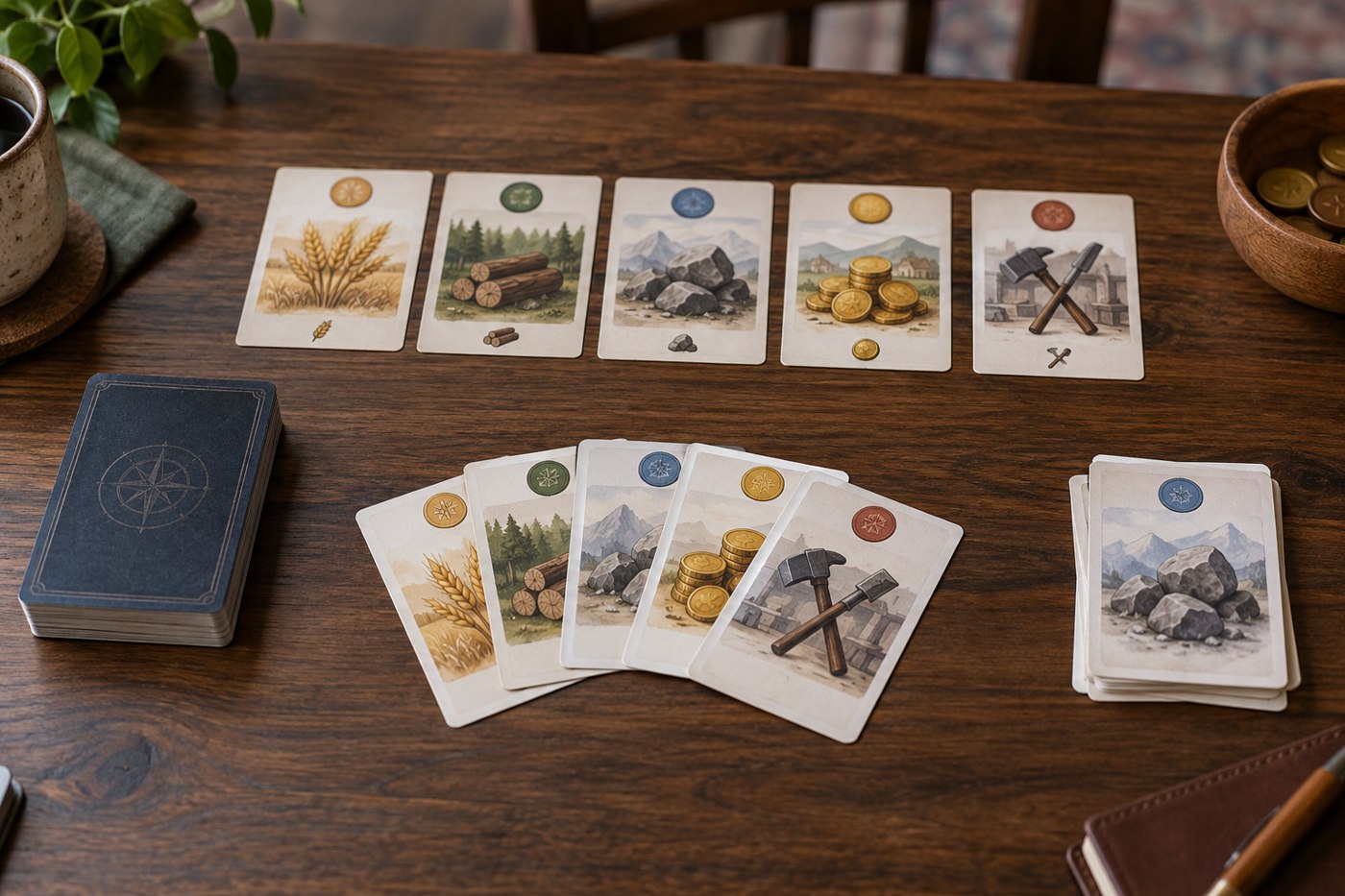
Find the personal draw pile, hand, play area and discard pile. A common sequence is to draw a hand, use cards, discard them and eventually shuffle the discard pile into a new draw pile. That sequence is not universal, so check the particular rules for gaining cards, reshuffling and ending a turn.
Track a newly acquired card physically. Does it enter your discard pile, your hand or the top of your deck? The destination determines when it can help. A powerful card gained just after a reshuffle may take several turns to appear, while a weaker card placed directly into your hand may matter immediately. Its printed effect is only part of its value.
Dominion is a clear published example of personal decks developing during play, with separate Action, Buy and Clean-up phases. Other deck-building games use different turn structures. Learning one title helps you recognise the cycle, but does not make its restrictions the rules for every game in the genre.
Think about the hand you want to draw
Imagine a simple illustrative deck with ten cards, five of which produce money. You draw five cards per turn. Adding a useful attack card gives you a new possibility, but that card may replace a money card in a future hand. Whether this helps depends on what the attack achieves and what you need money for.
A card that looks strong alone may require another card to work well. If one provides a bonus only when paired with a particular symbol, consider how often both will appear together. A large deck can make a rare pairing unreliable. More copies, extra drawing or selective discarding may improve consistency, but each solution has its own cost.
Distinguish gaining from improving
A larger deck is not automatically a stronger deck. New cards can add useful effects, dilute a combination or make it take longer to see your best cards again. Before buying, ask what the card changes about an ordinary future turn. A modest effect that you can use reliably may outperform an impressive one with difficult conditions.
Some games let you remove cards permanently. Removing a weak card can make stronger cards appear more often, but it also costs an action or resource and reduces whatever useful function that weak card still supplied. Do not remove every basic resource card simply because thinning is often discussed as good strategy. Your deck still needs to perform the tasks required to win.
Check the limits on using your cards
Drawing several useful cards does not help if you cannot play them all. A game may limit actions, require resources to activate effects or permit only one use of a particular type. Before acquiring another action card, check whether your deck has enough capacity to use the action cards it already contains.
Order can matter within the same hand. A drawing effect may reveal information that changes your later choice, while an effect that discards cards may be stronger before your hand shrinks. Resolve each instruction fully and follow the game's timing rules. Do not carry a benefit forward or use a newly gained card immediately unless the rules allow it.
Watch the supply and the finish
The shared market is part of the game, not just a catalogue for your private plan. A card may disappear before your next purchase, a row may refresh or a depleted pile may help trigger the ending. Notice which resources opponents are acquiring, while remembering that their hidden hands can make precise predictions impossible.
Deck improvement needs time to pay off. Near the end, a card that would strengthen several future turns may never be drawn. Direct points or an immediate effect may become more useful. Estimate how many deck cycles remain rather than continuing an early-game building plan out of habit.
This shift is particularly important when scoring cards do little during ordinary turns. Buying them may weaken your short-term draws while advancing the actual victory condition. The right moment depends on the game's ending and your position; a beautiful resource engine that earns no final score has missed its purpose.
Learn from a cycle rather than one lucky hand
After a game, consider how often the cards you bought became useful. Did a combination actually appear? Did you repeatedly hold cards you could not activate? Did you buy an improvement too late to draw it? These questions reveal more than judging a purchase by one unusually good or bad hand.
Keep early learning focused. Try a coherent plan involving a small number of complementary effects, then adjust when the market or other players make that plan impractical. You do not need to memorise every possible combination before your first game. Understanding where cards go and when they return provides the foundation.