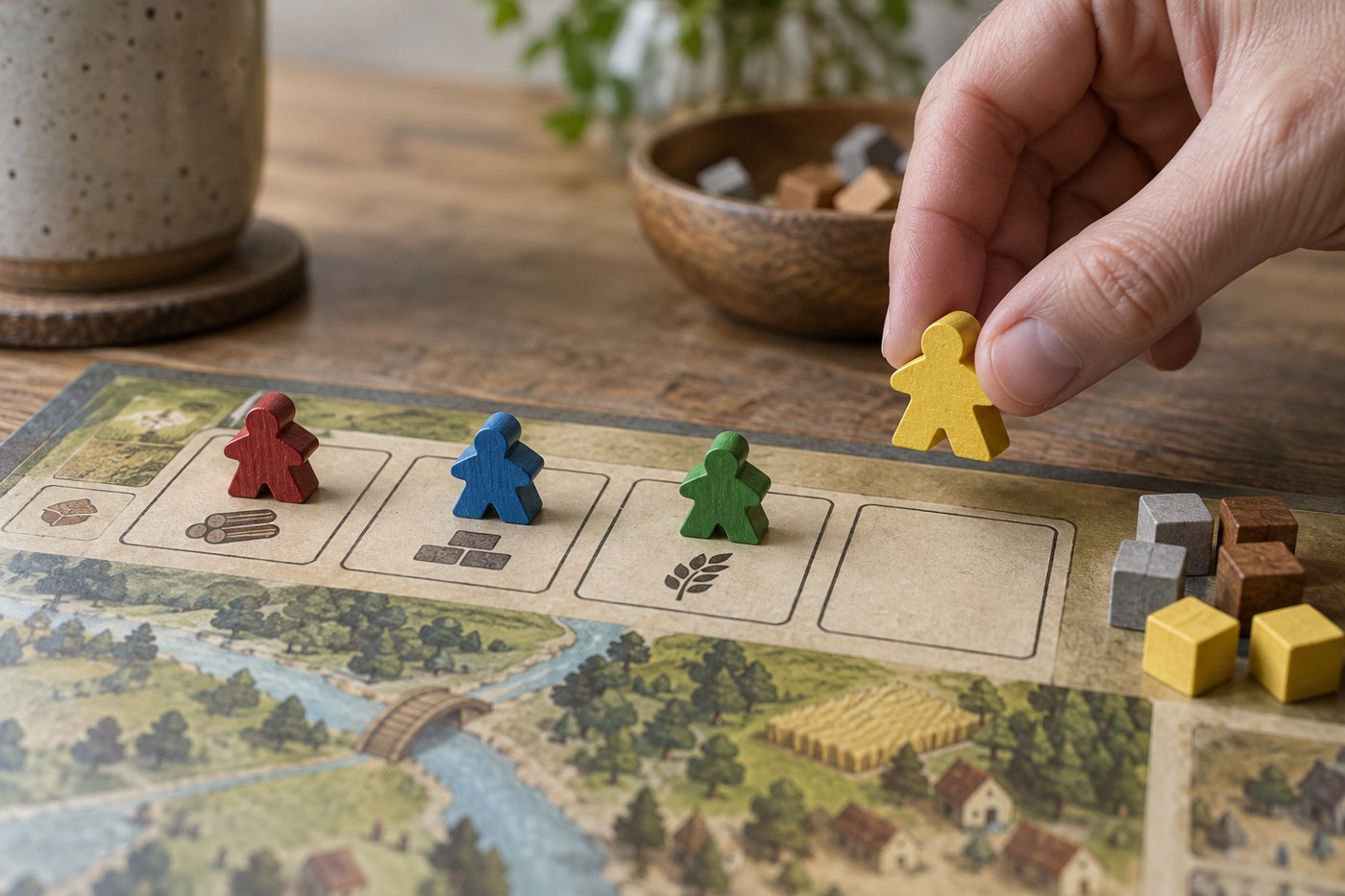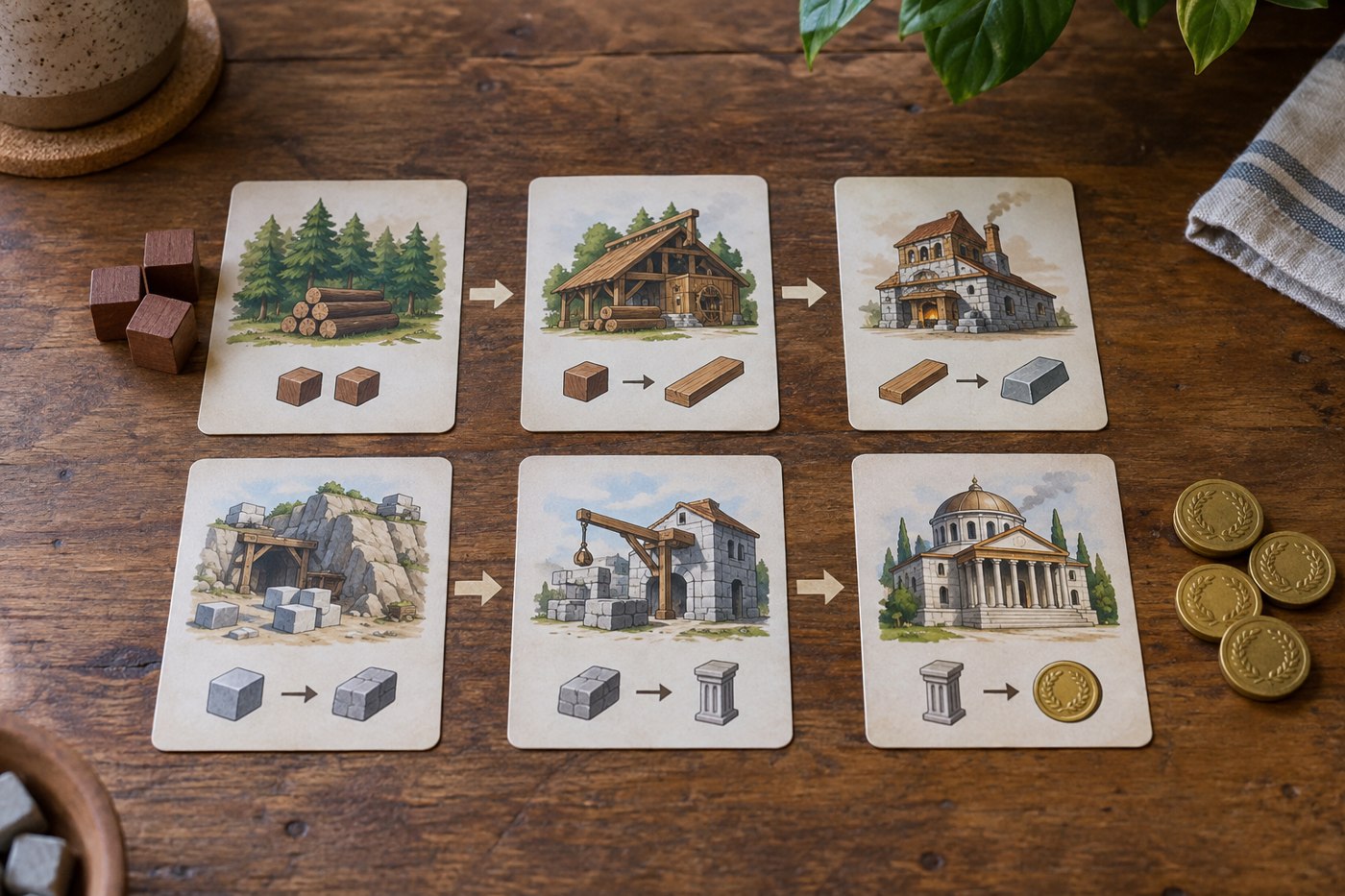
Identify what the engine produces
An engine may generate money, cards, movement, actions, discounts or points directly. Name its output before comparing improvements. Two effects that both look powerful may solve different problems, and a resource is useful only if the game gives you a worthwhile way to spend it.
In an illustrative workshop game, one machine produces wood whenever you take a gathering action. Another machine turns wood into furniture, and furniture scores points when sold. The engine is the relationship between those steps, not merely the number of machines in front of you. Extra wood production will not help much if you can sell only one piece of furniture before the game ends.
Count the cost beyond the printed price
An improvement may cost resources, a turn, a worker or the opportunity to choose something else. If installing a machine uses the same action that could have sold furniture, include the forgone sale when evaluating it. A cheap purchase can still be expensive in time.
Also consider prerequisites. An effect that requires a building and a particular card is a larger investment than its final purchase price suggests. Check whether you already have those prerequisites or must spend more turns acquiring them. Avoid evaluating the finished combination as though all its pieces arrived for free.
Some costs are ongoing. A machine may consume fuel each time it runs, or an action may require discarding a card. Calculate the net benefit rather than counting only the reward icon. An engine that produces three resources but spends two to activate has a different role from one that produces three without further payment.
Estimate how often it can activate
A bonus triggered every round has a different time horizon from one triggered only when you choose a particular action. Count realistic activations, not theoretical maximums. If you expect to gather twice more, a gathering bonus should be judged on those two uses unless another part of the plan changes that expectation.
Read timing terms precisely. 'When played', 'once per round' and 'whenever you take this action' are different instructions. A newly installed effect may not apply to the action that installed it. If a chain depends on a timing interaction, check the relevant rules before spending the resources.
For a simple comparison, suppose an improvement costs four coins and produces one coin at the end of each remaining round. With two rounds left, it returns only two coins through that effect. It may still offer points or another benefit, but the income alone does not repay the cost. This arithmetic is a useful question to ask, not a universal strategy formula.
Find the bottleneck
An engine can become unbalanced. You may draw many cards but lack actions to play them, produce materials but lack conversion opportunities, or obtain discounts without enough purchases to use them. Identify the step that limits the whole process before adding more output elsewhere.
In the workshop example, improving the furniture machine could be more valuable than adding a second wood source if unused wood already piles up. Alternatively, extra sales capacity might be the real need. Look at what repeatedly remains unused at the end of a turn; it often points toward a missing connection in the system.
Keep the rules visible while resolving chains. Move spent resources away, mark used effects where the game provides a method and resolve each trigger in the correct order. A complicated engine should not rely on remembering that three identical bonuses were already counted. Clear physical bookkeeping protects both speed and accuracy.
Leave room to react
A narrow engine can be efficient but fragile when it depends on a contested action or a card that has not appeared. Build alternatives when the cost is reasonable. Flexibility might mean a second scoring route, a way to convert an unwanted resource or an action that does not depend on the shared market.
Watch the end condition and opponents' progress. Another player may finish the game sooner than your engine expects, even if you personally have more improvements to build. A plan should include a way to earn useful rewards before reaching its ideal final form. The game does not pause while every player completes a satisfying machine.
Change from building to earning
Near the end, compare another improvement with using what you already have. An extra point-producing action may be worth more than a discount that will apply only once. The transition is rarely announced by a rule; it follows from remaining opportunities and the current position.
After play, review which effects actually activated and where resources went unused. A card that looked modest may have quietly helped every round, while an elaborate combination never paid back its setup. Use those observations to refine your next plan, without assuming one game's result proves an improvement is always good or bad.