Learn how the game defines control
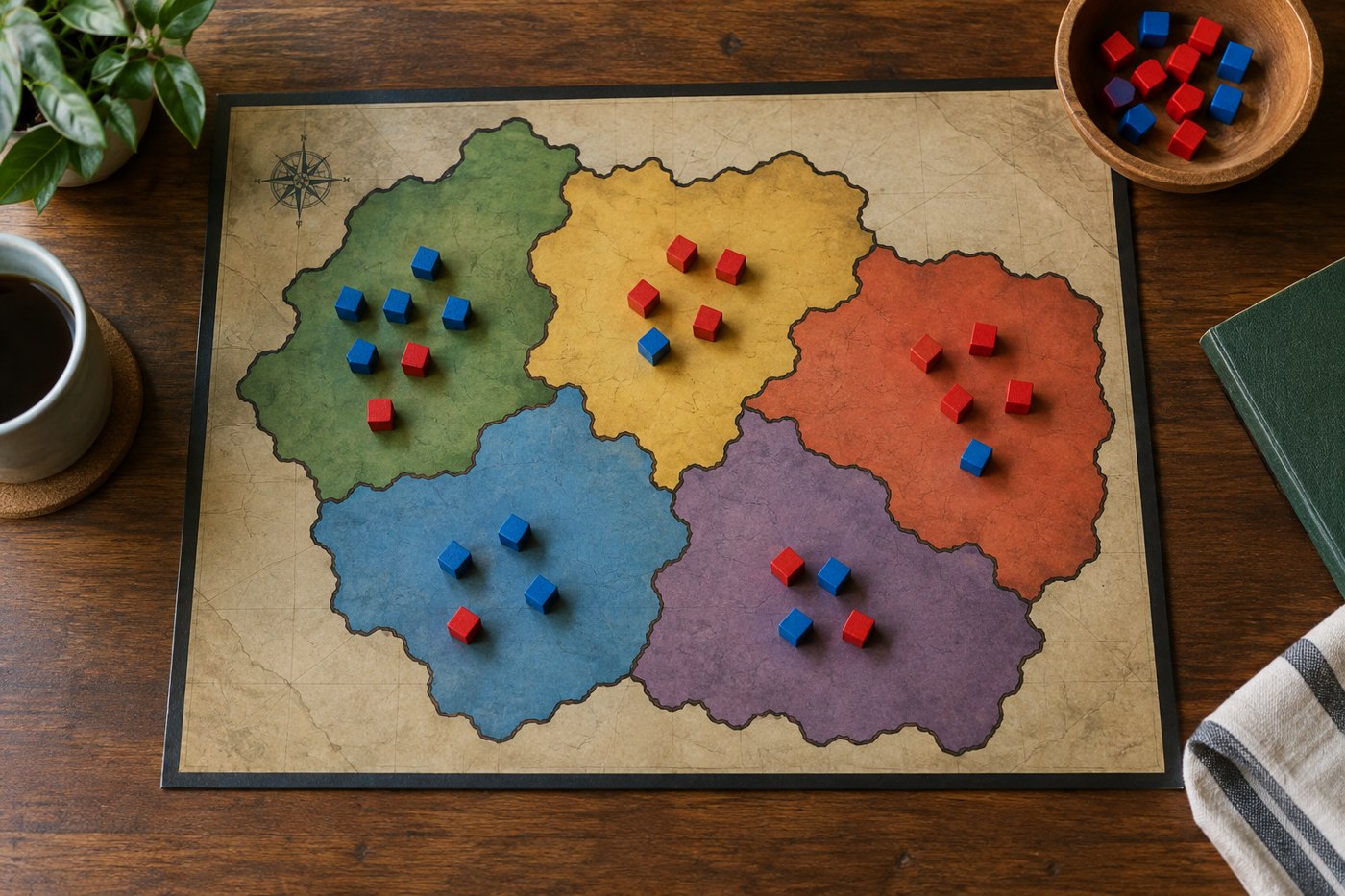
Control may require the most pieces, a particular kind of unit, a strict majority or an unopposed presence. Some games distinguish control from simply occupying a region. Read the definition rather than assuming that a piece on a space makes the space yours.
Check ties carefully. A tie might deny everyone the reward, share it, preserve the previous controller or favour a specific player. A single extra piece can therefore have very different value across games. Also identify whether buildings, markers or special powers contribute to influence separately from mobile units.
Know when the map is evaluated
A region may score every round, only at the end or when a specific event occurs. If scoring happens after everybody has acted, a lead secured early may be easy to overturn. If a region scores immediately when claimed, arriving first may matter more than holding it for several rounds.
Put scoring moments into your plan explicitly. In an illustrative game with scoring after the fourth round, occupying a valuable region during the first round creates an opportunity but not a guaranteed reward. You still need to consider who can enter before evaluation and what defending the lead will cost.
Count the marginal value of another piece
The first piece in an empty region may earn access or a minimum reward. A second might establish control. A fifth may add nothing if nobody can challenge four. Compare what one additional piece changes rather than judging a region by the total army already there.
Spreading widely can earn several small rewards, but it may leave every position vulnerable. Concentrating can secure a valuable region while abandoning the rest of the map. Neither approach is always correct. Look at scoring differences, movement routes and opponents' remaining opportunities before deciding whether to reinforce or expand.
Do not defend a region solely because you invested there earlier. If maintaining it now costs more than the reward is worth, retreating or redirecting resources can be sensible. Earlier commitments matter because of the current position they created, not because they must be justified forever.
Read movement and access
Adjacent spaces on the artwork may not be connected by the rules. Roads, borders, water or special routes can determine where pieces move and how quickly. Check whether moving through an occupied area is legal and whether control opens or closes a route.
A modest region can be important because it connects two others or provides a place to enter the map. Conversely, a high-scoring region may be difficult to reach and expensive to reinforce. Consider the route required for both arrival and escape. A force trapped after taking points can still create a future disadvantage.
Account for opponents without assuming certainty
Watch public resources, movement capacity and visible scoring needs. If another player can add only one piece before scoring, you can estimate what it takes to hold a lead. Hidden cards or special powers may complicate that estimate, so leave room for uncertainty rather than treating the visible map as complete information.
Interaction can involve negotiation as well as placement. Follow the game's rules for deals and promises, and do not mistake a casual statement for a binding agreement. If several players can challenge a leader, each may prefer somebody else to pay the cost. That shared incentive does not guarantee coordinated action.
Consider your position in the scoring order as well. A move that denies a rival five points while gaining you one creates a different relative change from gaining three in an uncontested region. That comparison is useful, but remember other opponents benefit from the denial too. In a multiplayer game, hurting the visible leader does not automatically make you the player most likely to win.
Keep the state easy to read
Place pieces wholly inside their regions and separate colours or types enough to count them. Avoid decorative stacks that hide how much influence is present. If the map is crowded, confirm totals aloud when a contested region scores.
During a first play, use a small example to demonstrate an empty region, a clear lead and a tie. Then show the scoring moment. Players need to understand how presence becomes a result before they can judge whether a move is aggressive, defensive or simply wasteful. Once those basics are clear, the map becomes a set of meaningful commitments rather than a display of scattered pieces.