Find the intended stopping point
Look for the campaign's published save or checkpoint instructions. Many games are designed to stop between scenarios, while others support saving at particular points inside one. A photograph of a mid-turn board does not automatically make that position recoverable under the rules.
Finish the required resolution before packing. Rewards, losses, unlocks or story notes may become permanent only at the end of a scenario. Read the sequence fully so you do not save before applying an important consequence or apply a reward twice when the group returns.
Separate lasting progress from current state
Campaign records may include unlocked scenarios, character development, resources, decisions and specific story flags. Temporary state can include current health, cards in hand, a round number or a partially resolved effect. The rules determine which persists; do not assume all visible information carries forward.
Use the exact labels required by the campaign when recording mechanical information. A paraphrase can be fine for your personal story recap but may be ambiguous when a later instruction checks for a particular recorded phrase. Keep the official campaign log distinct from informal notes about what the group hopes to do next.
Fantasy Flight Games provides campaign rules and logs for Arkham Horror: The Card Game, and Cephalofair provides campaign resources for Gloomhaven. These are examples of why the game's own record is the starting point. Different campaigns preserve different information, so do not transfer one game's saving habits wholesale to another.
Pack by the next setup task
Keep each character's persistent materials together, clearly labelled by character and player where relevant. Separate shared resources, unlocked content and still-unavailable content. A storage arrangement should make it difficult to accidentally add a locked card to an ordinary draw pile.
Preserve deck order only when the rules require it, and preserve the deck's membership whenever that matters. If a deck contains added or removed cards, record or bag it so those changes survive. Do not shuffle automatically during cleanup; a campaign may rely on the order or a specific separation between used and unused cards.
Avoid rubber bands directly around delicate cards if they can bend or mark them. Use suitable bags, dividers or boxes without forcing the lid closed. Storage should protect the saved state physically as well as logically.
Use photographs for the information they capture well
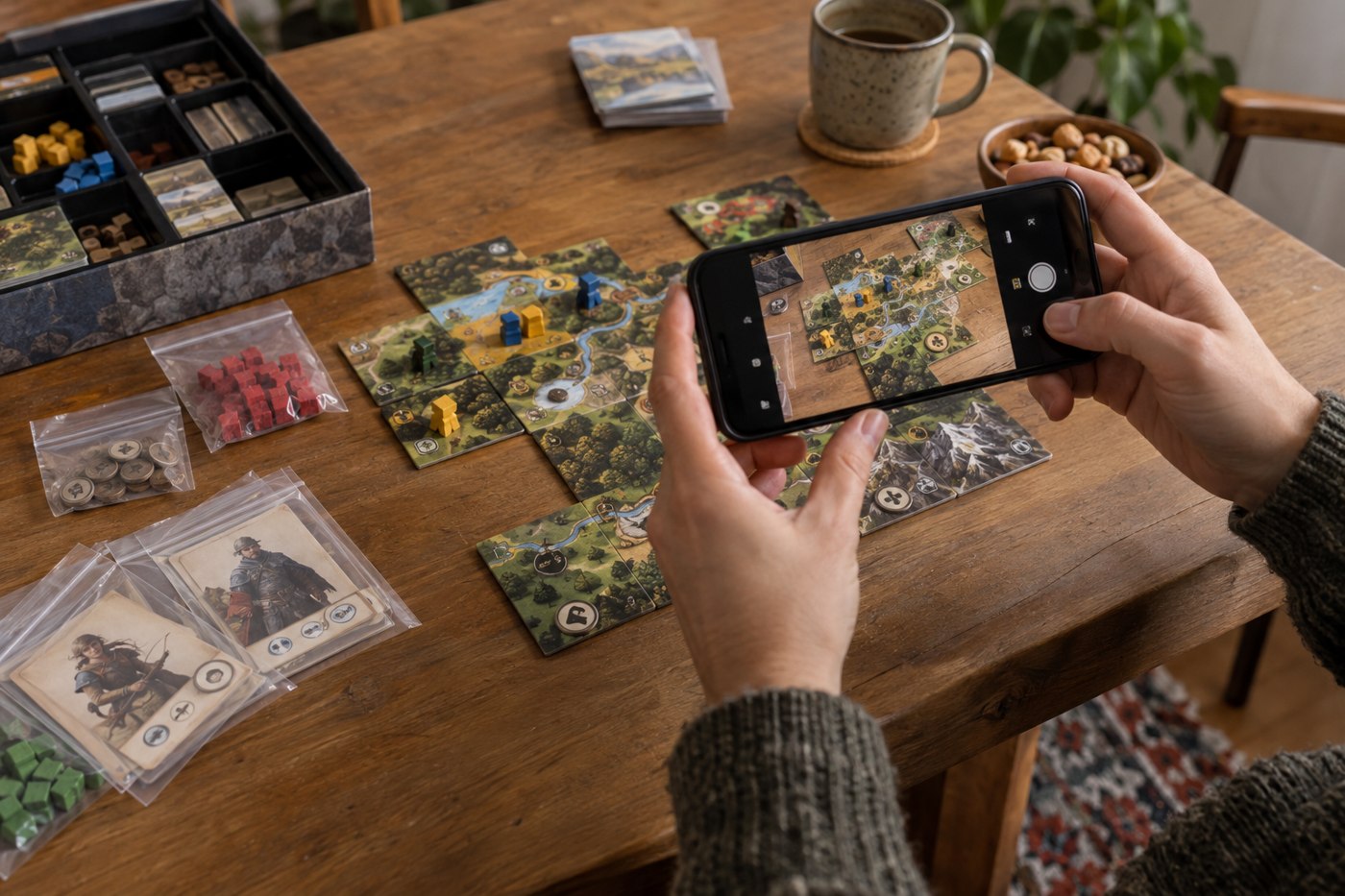
Photographs are useful for public board layout, token positions and module orientation. Take them from directly above where possible, with enough light to distinguish small pieces. Include a close view of crowded areas rather than relying on one distant image.
Photos are weaker for face-down decks, tiny track values and distinctions between similar cards. Add a short written note for those details. Check images before packing and avoid exposing hidden hands or sealed content to players who should not see them. Store the images where the relevant group can find them when needed.
Write a restart note
State the next scenario or decision, the current stopping point and any unresolved rules question. If you stopped during a supported save point, record whose action comes next and which phase is complete. A sentence such as 'round cleanup finished; begin the next event' can prevent an accidental repeated phase.
Add a brief narrative recap if the game has a story, but keep it separate from required state. Two or three sentences about the last important choice may be enough. Avoid including information one player discovered privately unless the game permits sharing it.
Verify before the box closes
Read the save instructions once more and compare them with the log and packed components. Confirm that rewards have been applied, temporary effects reset where required and newly unlocked material placed in the correct section. Ask another player to check the record if available.
Finally, label the save with the campaign name and date. If several campaigns or groups use the same box, keep their records clearly separated and check whether components can actually support parallel play. A correct save is only useful if the next session restores the intended campaign rather than a mixture of two different histories.
If the next session uses a different location, check that the saved groups can travel without spilling or exposing private cards. A correct record will not help if an unsealed bag mixes two carefully separated decks during the journey.