Check that the format is supported
Read the solo and player-count instructions before adding another character. Some games explicitly support one person controlling several roles; others have a dedicated one-character mode. Check how enemy strength, setup and objectives scale. The relevant count may be characters, players or another defined quantity.
Also check communication and hidden-information assumptions. A cooperative game that relies on players not knowing one another's hands may lose that challenge when one person sees everything. Use a published solo adaptation if available rather than assuming that controlling both sides creates the same experience.
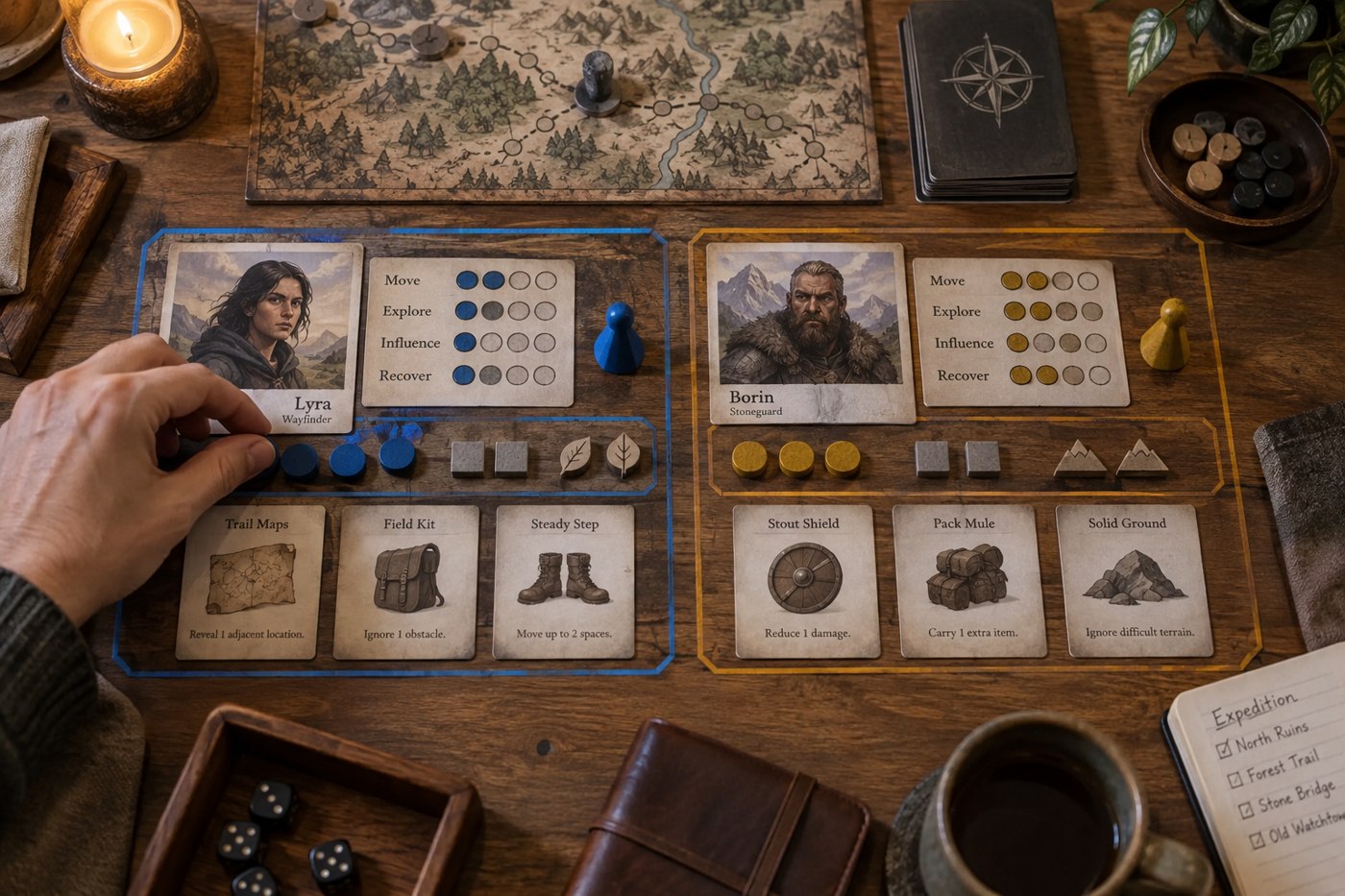
Give each character a complete physical area
Separate hands, discard piles, resources and persistent equipment. Leave a visible gap between areas, and use the character's own board or marker to establish ownership. Avoid a shared pile of identical resources if the rules require each character to pay from their own supply.
Arrange the areas in the order you normally resolve turns. Place shared components centrally, with enough room to move between personal and common information without crossing piles. A large table is not always necessary, but every zone should have an unambiguous purpose.
If using card holders, make sure they hold enough cards for the largest hand each character can have. A holder that fits only the opening hand can become confusing later. Keep a character's temporary effects close to that character rather than spreading them around the central board.
Track whose action is in progress
Use the game's active-player or action markers where supplied. If an additional reminder is permitted, place it beside the character currently acting and move it only after their turn is complete. This reduces the chance of starting another character's move before resolving the first one's upkeep.
Read the full action sequence for each role, especially if they differ. One character may draw at the beginning and another at the end, or an ability may trigger when a teammate acts. Keep those triggers visible and resolve them at the correct point. Do not assume a shared controller allows timing shortcuts.
When interrupted, write the next step rather than relying on memory. 'Character A has acted; character B still has two actions' is more useful than a general photo of the table. If a particular effect remains unresolved, record it before stepping away.
Coordinate without inventing shared resources
Seeing every hand can make combinations easier to plan, but legal transfers still follow the rules. A card useful to another character cannot simply move into their hand unless an action or ability permits it. The same applies to money, equipment and information.
Plan the order of cooperation explicitly. One character might clear a route so another can move, or provide a bonus that applies only during a certain phase. Check whether the helping action happens early enough and whether its target meets the conditions at that moment. A combination that works conceptually may fail on timing.
If the game includes personal objectives, decide how the published solo mode handles them. Do not silently ignore a character's requirements because a team-wide plan seems more efficient. Those constraints may be an intended part of the experience.
Keep the number of roles manageable
Start with the smallest supported multi-character setup while learning. Adding more roles increases not only rules volume but also the number of interactions you can consider. A turn can become slow because you are comparing every possible combination, even when each individual character is straightforward.
Use familiar characters before combining several unfamiliar ones. You can introduce one new role while keeping another well understood. This makes it easier to identify whether a problem comes from the new ability, the overall scenario or a bookkeeping mistake.
If the session becomes more administration than enjoyment, reduce the character count next time using the correct setup. There is no requirement to control the largest party the box permits. The best count is the one that gives you the decisions you want at a pace you enjoy.
Save ownership as carefully as position
When packing a supported save, keep each character's current materials together and label them. Record health, resources, hand state and other required values individually. A pooled record may preserve the total while losing the distribution that matters.
At the next session, restore each character fully before resuming the shared state. Then check turn order and unresolved effects. A two-minute ownership check prevents accidentally giving one role a card or resource earned by another.