Rebuild only the relevant position
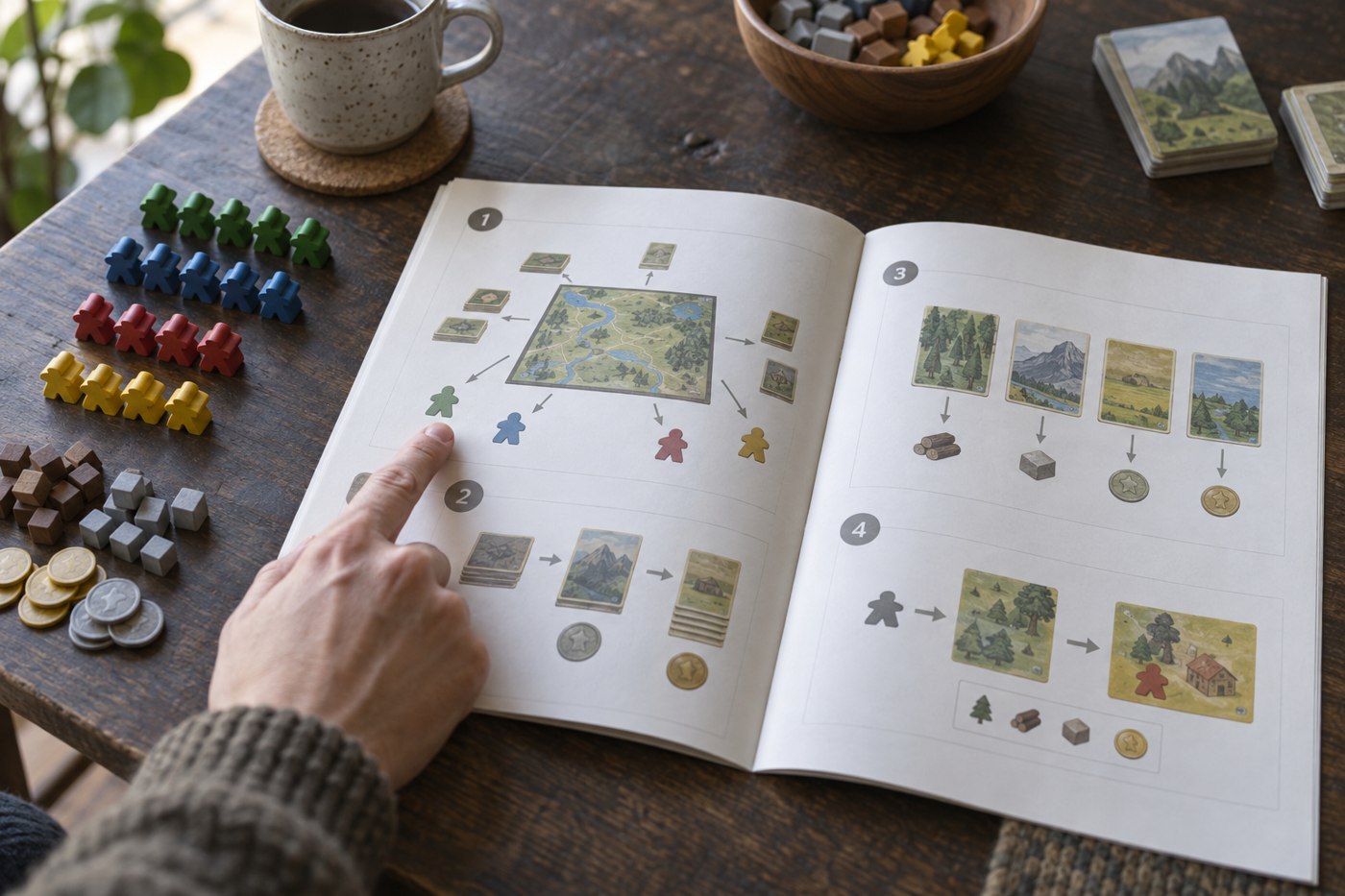
Read the entire example before collecting pieces. Identify the active player, the starting resources and the action being demonstrated. Place only the objects needed to show that interaction. A crowded full setup can hide the relationship the example is meant to explain.
Check whether the illustration shows the position before or after the action. An arrow, a faded token or a highlighted card may represent movement rather than an extra component. Compare the accompanying text with the picture. If the example uses a different colour from your preferred player colour, preserve the roles rather than getting distracted by the colour choice.
Perform one instruction at a time
Read the first relevant sentence, move the piece and pause. State what changed in ordinary language: the player spent a resource, the worker now occupies the space, or the card moved to the discard pile. Then continue to the next sentence. This makes it easier to notice an instruction that would otherwise disappear inside a fluent read-through.
Keep costs visibly separate until the example is complete. If payment immediately returns to a communal tray, it can be difficult to reconstruct why the final supply is lower. After confirming the result, return those pieces to their proper destination. The temporary separation is a teaching aid, not a new rule for regular play.
Compare your result with the printed result
Count the final resources and locate every moved piece. If the totals disagree, retrace the first point where your position diverged. Look for a conditional instruction, a prerequisite or a cap on rewards. Repeating the entire example faster usually preserves the same misunderstanding.
Be cautious about inferring a general rule from a single picture. An example can show a legal placement without showing every other legal placement. Read the surrounding rule to discover which feature makes the move valid. The game may care about adjacency, ownership or terrain rather than the visually obvious colour of the destination.
Change one detail to test understanding
Once the printed sequence works, alter one non-secret detail and predict the outcome before moving anything. Give the player one fewer coin, block a space or change the order of two eligible actions. Ask whether the action remains legal and which part of the rule supplies the answer. Changing several variables at once makes the result harder to interpret.
Keep invented examples clearly labelled as your own. If the rulebook does not answer a new situation, write down the question for an official clarification rather than presenting a guess as a rule. Teaching a table includes making the boundary between a demonstrated rule and an unresolved question visible.
Let another player operate the pieces
When teaching, invite a listener to perform the same sequence while you give only the required prompts. They will often notice a destination or timing issue that was hidden when you did everything yourself. Give them time to finish before correcting a harmless hesitation; moving slowly is not the same as misunderstanding.